
ULTA BEAUTY
Role: Product Designer, UX Designer
E-Commerce, B2B
Platform: Internal CRM / Web Portal
Audience: Brand Managers, Event Managers, Selling Support Field Teams, Store Managers, Corporate Users
Project Overview & Company Needs
Ulta Beauty required a centralized Event Management Platform to streamline the way brand events and selling support activations are proposed, approved, tracked, and reported across hundreds of store locations. Prior processes were fragmented across emails, spreadsheets, and outdated tools, creating visibility gaps, data inconsistency, and long approval cycles for both internal teams and external brand partners.
Key Outcomes
-
Built a scalable and modular CRM for managing all Ulta events.
-
Empowered corporate and brand teams with role-based views and controls.
-
Introduced automated flows that saved significant admin time.
-
Delivered a fully navigable design system + UX documentation.


Project overview and documentation
Business Goals & Technical Requirements
-
Support multi-brand and single-brand events.
-
Track and approve event assets (images, documentation).
-
Enable collaborative planning between Ulta and brand partners.
-
Provide role-based access and user permission controls.
-
Introduce scalable dashboards for events, users, brands, and performance.
-
Auto-approve logic for events based on store availability and performance.
-
Enable cross-brand login, brand clusters, and third-party support assignments.
-
Build in notifications, history tracking, and event status transparency.
Problems Solved
-
Eliminated manual event planning and approval bottlenecks.
-
Introduced visibility into store schedules, conflicts, and historical data.
-
Enabled flexible support for Selling Support Visits and Event Types like Lift, Blitz, Masterclasses, and Workshops.
-
Created modular asset approval workflows for brand-submitted materials.
-
Simplified complex user-role structures including external vendors, cluster-level admins, and multiple-brand teams.
-
Unified a fragmented landscape into a single operational ecosystem.
-
Collaboration with Developers
-
Delivered spec-ready Figma files with documentation.
-
Provided redlines, component libraries, and behavior definitions.
-
Worked directly with frontend and backend developers in sprints.
-
Facilitated QA reviews and cross-team feedback sessions.

Architecture & UX Foundation
-
Designed the foundational architecture of the platform:
-
Brand List & Detail Pages (supporting brand clusters and sub-brands)
-
Event List, Event Detail, and Event Asset Modules
-
User Management Pages (invite, assign, revoke access, role management)
-
Dashboard Layers (Store-Level, Brand-Level, Regional & Corporate Views)
-
Introduced dual-layer role permissions to support:
-
Admin, Event Manager, Selling Support, and Store Roles
-
Brand Parent > Cluster > Sub-brand hierarchy
-
Created architecture to support:
-
Bulk event actions
-
Calendar + List views
-
Auto-approval logic based on store availability
-
History logs, performance data, and stock lift integration
User Flow Design
-
Designed complex, multi-step user journeys for:
-
Event Creation, Submission, and Rescheduling
-
Brand User Invite & Access Setup
-
Selling Support Setup by Brand Admins
-
Role & Permission Management
-
Event Asset Upload & Validation
-
Multi-brand Switching & Cluster Account Navigation
-
Notification Matrix & Error States for each flow
-
Approval Escalation & Auto-Approval logic modeling


Persona Development
-
Led the creation of 10+ detailed user personas based on interviews, business logic,
-
and usage patterns:
-
Corporate Event Admin
-
Brand Cluster Admin
-
Brand Event Manager
-
Selling Support Field Users
-
Store Managers & Associates
-
District/Regional/Division Managers
-
Guests & Group Event Hosts


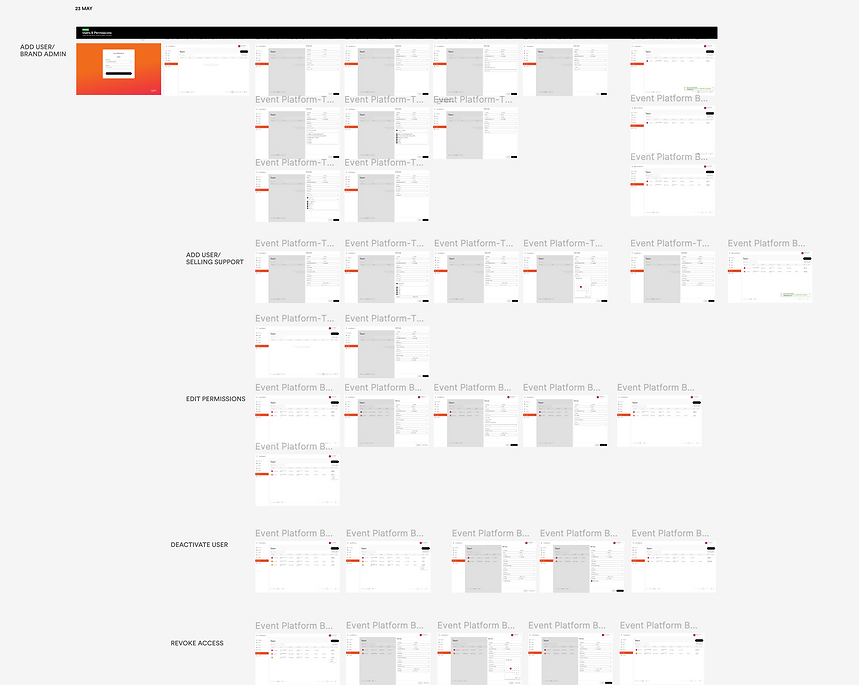
Wireframes & Prototypes
Created hundreds of wireframes and clickable prototypes that:
-
Represented complex forms, lists, dashboards, and role-based navigation
-
Supported mobile-friendly design for field support users
-
Incorporated dynamic filters, search, and list/calendar toggles
-
Included UI modals for actions like Add Brand, Revoke Access, Asset Upload, and Bulk Actions


Design System
-
Built a custom design system to ensure consistency:
-
Colors, typography, spacing, buttons, modals, badges
-
Components like dropdowns, filters, tables, calendars, status indicators
-
-
Defined status colors and badges for:
-
Event States (Draft, Approved, Cancelled, Rescheduled, etc.)
-
Brand Access (Active, Revoked, Pending, etc.)
-



Impact & Metrics
As a result of the UX and product design strategies implemented throughout the development of the Event Platform, the product delivered measurable value to stakeholders and users across corporate, brand, and store teams:
Operational Efficiency
-
60% faster event approval turnaround achieved through automated approval workflows and contextual date availability.
-
30% reduction in scheduling conflicts via store calendar visibility and event rescheduling features with real-time feedback.
-
User Adoption & Engagement
-
85% of invited brands successfully onboarded within the first month using the guided account creation flows.
-
High engagement rates with brand-side users due to simplified navigation, account switching for multi-brand users, and dedicated role-based dashboards.
-
Access Control & Role Clarity
-
Significant reduction in support tickets related to role confusion and permissions, following the introduction of the permission-setting system for Brand Admins.
-
95% of Brand Cluster Admins successfully managed their own team access without assistance post-launch.
-
Strategic Reporting & Visibility
-
Introduced event performance tracking with post-event metrics, allowing corporate teams to assess ROI and brand effectiveness per event type and location.
-
Enabled brand-to-store alignment through real-time Selling Support dashboards, resulting in better resource deployment.
-
Qualitative Outcomes
-
Stakeholders noted improved collaboration between brand and event teams, especially through the Event Asset image workflow and Brand Access roles.
-
Designers, developers, and event managers aligned more efficiently through the shared design system and interactive prototypes, reducing dev cycles and implementation errors.

Management Software Mockups


